
What is Hermes Agent?
Hermes Agent is an open-source AI agent from Nous Research designed to remember, learn, and improve over time. Unlike traditional assistants that forget past work, it combines persistent memory, reusable skills, parallel subagents, and self-hosted infrastructure to create an AI system that accumulates capability across sessions rather than starting from scratch.
What Is Hermes Agent?
Most AI agents forget everything when you close the tab. Nous Research built Hermes around the opposite premise.
There's a pattern across almost every AI agent released in the last two years. You give it instructions, it does impressive things, you come back the next day and it has no idea who you are or what you were working on. Each session starts from zero.
Hermes Agent, built by Nous Research and released in February 2026 under MIT License, was built as a direct answer to that. It's an open-source autonomous agent that lives on your server, builds persistent memory across every session, and writes reusable skills when it solves hard problems. The longer it runs, the better it gets.
Memory that actually scales
The naive approach to agent memory is saving conversation history and loading it back next time. Hermes does something more sophisticated: FTS5 full-text search across past sessions, LLM-driven summarization on top of that, and agent-curated memory with periodic nudges. Three layers doing different jobs.
Raw transcript storage is not the same as usable recall. Hermes was built with that distinction in mind.
It also integrates with Honcho for user modeling, meaning over time it builds a model of your preferences and working style, not just your history. The memory scales across months of use without degrading into stale context that breaks responses.
Subagents, skills, and compounding capability

When you give Hermes something complex, it can spawn isolated subagents, each with their own terminal session and Python RPC scripts, running up to eight in parallel. Results fold back into the main conversation without bloating your context window. Nous Research calls these zero-context-cost pipelines, and it's a real architectural solution to one of the most annoying practical problems in agentic AI.
The skills system is what most people overlook. When Hermes solves a problem it hasn't seen before, it writes and saves a reusable skill. Next time, it doesn't reason through it from scratch, it calls the skill. That's a compounding capability curve, not a marginal efficiency gain. There's also a Skills Hub for sharing community-built skills, which is the ecosystem play here.
Infrastructure and security done right
Six terminal backends: local, Docker, SSH, Singularity, Modal, and Daytona. Run it on a five dollar VPS or a serverless Modal environment that hibernates between sessions. The Docker backend includes read-only root filesystems, namespace isolation, dropped capabilities, filesystem checkpoints, and a pre-execution command scanner. Not bulletproof, but meaningfully more restrained than most agent frameworks that just let the model do whatever it decides.
It reaches you wherever you work
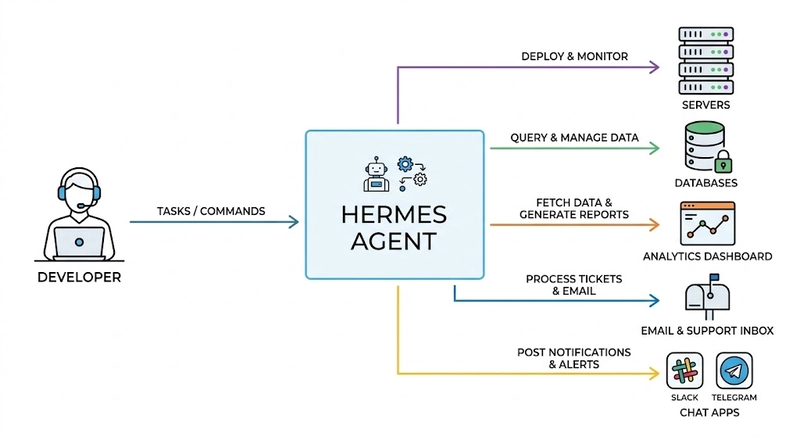
Telegram, Discord, Slack, WhatsApp, Signal, Email, CLI. You configure it once, and it's reachable wherever you already communicate. Start a task on Telegram, pick it up in the terminal. The session continues. That continuity across surfaces is underrated. When the agent is in your existing channels, you interact with it more naturally and more often, which compounds with the memory system.
The training data angle
Here's what reveals what Nous Research is actually building. Hermes can export tool-calling trajectories for supervised fine-tuning and RL training, with Atropos integration. Real agent usage generates real trajectories that improve the models powering the agent. That's a closed loop most AI labs don't have.
Honest limitations
Version 0.14.0 as of May 2026. Windows requires WSL2. The Skills Hub ecosystem is early. This is infrastructure-first, not consumer-friendly. You need to be comfortable running your own server. And any agent that executes code on your behalf carries inherent risk you should think carefully about.
Most AI agents are stateless tools pretending to be assistants. Hermes is a serious attempt at something that genuinely accumulates capability over time. Open source, self-hosted, your data stays on your machine. No telemetry, no vendor lock-in, no API deprecations you didn't ask for. The architecture is right and the trajectory is clear.
You may also like

What Is TypeSafe AI?
Discover Jev, TypeSafe AI’s System One Model for fast, type-safe, calibrated AI decisions built for software automation.

What Is Paperclip and How Does It Help You Manage AI Agent Teams?
Learn what Paperclip is, how it manages AI agent teams, controls costs, enables human approvals, and coordinates agents across different AI runtimes.

How Do You Actually Teach Engineering Judgment?
Learn how STEMLink teaches engineering judgment through a four-step approach: learn, build, test limitations, and understand why real-world systems need more.