
What AI Can't Do?
As AI homogenizes content in 2026, generic text loses its value. Discover why authentic human experience, original data, and deep technical expertise are the ultimate ranking signals under Google’s E-E-A-T framework, and why the tech industry is prioritizing human judgment over automated production.
What AI Can't Do?
Everyone has access to AI now. A startup founder in Colombo and a Fortune 500 marketing team in New York are both running the same models, generating content at the same speed, pulling from the same training data. The output is fast, it is polished, and it sounds confident.
It also sounds exactly like everything else.
That is the problem nobody talks about enough. When every company can produce unlimited content instantly, content itself stops being the advantage. What becomes rare, and therefore valuable, is content that could only have come from a specific human being who actually knows something.
The Internet Is Filling Up With Itself
Here is what is actually happening at scale. AI generates content based on what was previously published. That content gets indexed. Future AI models train on it. The next generation of AI generates content based on content that was already AI-influenced. Round after round, the web fills up with text that references text that references earlier text, none of which was grounded in original observation or direct experience.
Google noticed. After the March 2026 core update, websites that published original research, proprietary data, first-hand case studies, and content built on genuine expertise saw a 22% increase in organic visibility. Sites running scaled AI content without editorial depth lost rankings they had spent years building. Sports Illustrated was caught running AI-generated articles under fake author bylines with AI-generated headshots. When it came out, the content was pulled and the editorial trust the publication had built over decades took a hit it is still recovering from.
The market is correcting. Loudly.
What AI Actually Cannot Do
This is not a motivational argument for human writers. It is a technical one.
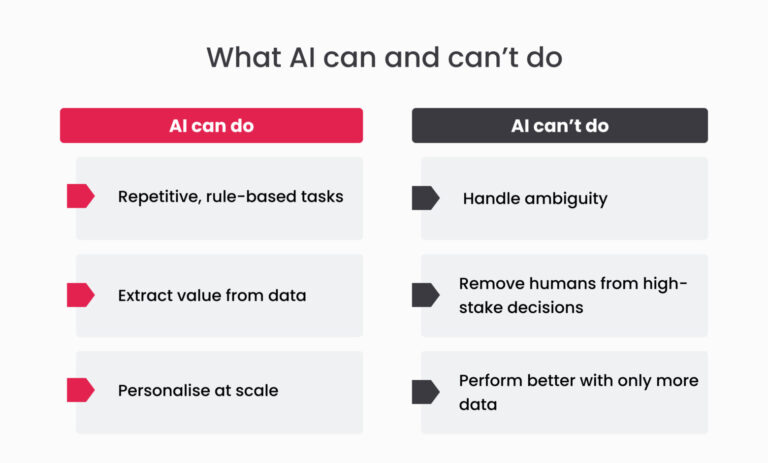
AI cannot have an opinion it actually holds. It can generate text that sounds like an opinion. It can argue any position you prompt it to argue. But it has no stake in the outcome, no professional reputation behind the claim, and no lived experience that led it to that conclusion. Readers feel this, even when they cannot articulate why.
AI cannot produce first-hand data. It cannot run a user interview, survey its own audience, ship a product, watch it fail, and write about what actually happened. It cannot tell you what it was like to be in the room when a startup pivot decision was made. Every piece of content AI generates is a recombination of what someone else already published. It has no original observations of its own.
AI cannot write with genuine technical depth on emerging topics. When a new framework ships, a new security vulnerability is discovered, or a new engineering pattern emerges, AI does not have reliable training data on it yet. The developer who has already spent three weeks working with it, hit the edge cases, and found what the documentation got wrong is the only person who can write that article accurately. That article ranks. Generic overviews do not.
AI cannot build trust through a name. A blog post with a real person's face, track record, and reputation attached to it carries weight that no AI-generated page can replicate. Google's E-E-A-T framework (Experience, Expertise, Authoritativeness, Trustworthiness) is specifically designed to reward this. In 2026, the Experience signal, actual demonstrated first-hand experience with the subject matter, is the one that is hardest to fake and most heavily weighted.
What This Means Across the Tech Industry
The gap shows up across every corner of the tech industry, not just content.

In software engineering, AI tools like Cursor and GitHub Copilot can generate code fast. What they cannot do is understand why the business needs what it needs, negotiate a technical trade-off with a product manager, or make a judgment call when two valid architectural approaches point in different directions. Senior engineers are not being replaced. They are being freed from the grunt work so the judgment part, the part AI cannot replicate, becomes the full job.

In product design and UX, AI can generate 20 layout variations in seconds. It cannot sit across from a frustrated user in a research session and notice the moment their body language changes before they can articulate the problem. It cannot read a room during a stakeholder presentation and adjust the narrative in real time. Those observations drive better products. AI does not make them.
In cybersecurity, automated tools scan for known vulnerability patterns. But the most dangerous threats are the ones nobody has seen before. Novel attack vectors, social engineering scenarios, zero-day exploits in freshly shipped systems. The security engineer who can think like an attacker, who brings intuition built from years of experience across different stacks and environments, is doing work that no model trained on historical breach data can fully replicate.
In data science and machine learning, AI can run models. It cannot decide which question is worth asking in the first place, or know when a statistically clean result is practically meaningless in the context of what the business actually needs. The analyst who bridges that gap between numbers and decisions is exactly the profile that teams are paying more for right now, not less.
The Practical Takeaway
Using AI as part of your content workflow is not the problem. Using AI as a replacement for the part that required you to actually know something is where the value disappears.
The most effective technical content in 2026 follows a clear pattern. A human with real experience forms the core argument. AI handles research support, structural suggestions, and editing passes. The human puts their name on it, adds the specific details only they could know, and takes a position worth reading.
Only 1% of content marketers say 100% of their published work is fully AI-generated. The people running content strategies that actually grow audiences know that the human layer is where the value gets created. AI handles the production work around it.
The writers, engineers, and technical experts who are building audiences right now are not the ones who learned to prompt better. They are the ones who have something to say that nobody else can say for them.
You may also like

What Is TypeSafe AI?
Discover Jev, TypeSafe AI’s System One Model for fast, type-safe, calibrated AI decisions built for software automation.

What Is Paperclip and How Does It Help You Manage AI Agent Teams?
Learn what Paperclip is, how it manages AI agent teams, controls costs, enables human approvals, and coordinates agents across different AI runtimes.

How Do You Actually Teach Engineering Judgment?
Learn how STEMLink teaches engineering judgment through a four-step approach: learn, build, test limitations, and understand why real-world systems need more.