
Product Thinking: The One Skill Nobody Teaches You in University
Every failed product has one thing in common. Someone built the solution before understanding the problem. Product thinking is the discipline that stops that from happening. And it is the skill tech companies are quietly testing for in every interview.
Product Thinking: The One Skill Nobody Teaches You in University
Most people who build things have a habit they are not even aware of. Someone describes a problem and their brain immediately jumps to a solution. A feature. A screen. A function. It feels productive but it is actually a trap, and it is one of the most common reasons products fail.
Product thinking is the discipline of resisting that jump. It is the practice of sitting with the problem a little longer, asking one more "why," and understanding the person behind the request before you ever open a code editor or design tool.
As a tech student, you are trained to solve problems by writing code. But product thinking is one level above that. It asks: are you solving the right problem in the first place?
"A customer asked for faster horses. Henry Ford gave them a car."
The classic story of finding the real need, not just the stated request.
The Four Pillars of Product Thinking
Product thinking is not one skill but four working together. When all four click simultaneously, that is when you truly have a product mindset.
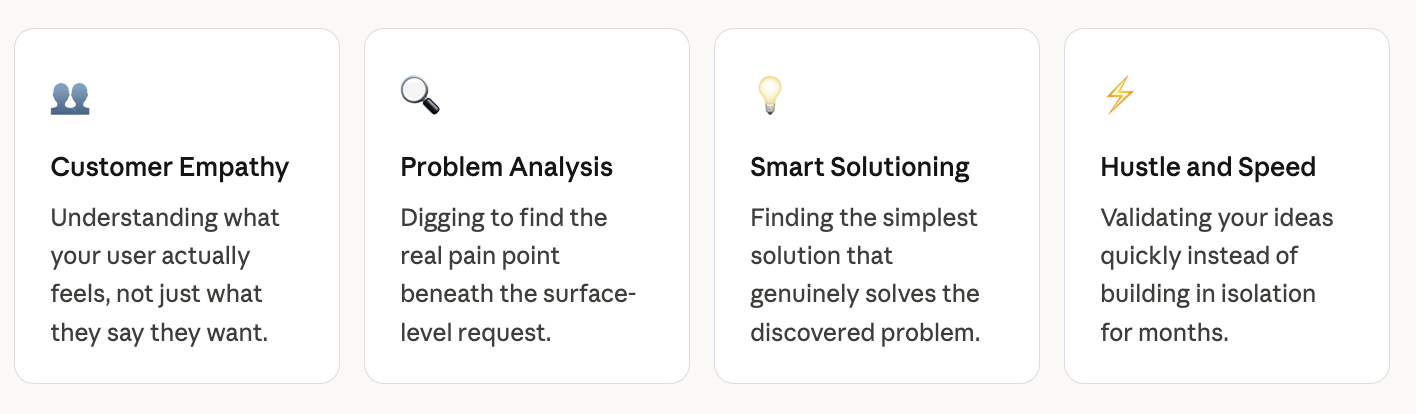
Notice the trap here. You can have three out of four and still fail. A user tells you they want an export button. You build it fast and it looks great. But did it solve their real problem? You showed empathy, solutioning, and hustle but you skipped problem analysis. That is not product thinking.
The Product Thinking Process: Three Diamonds
Great product teams use a structured way of thinking called the Triple Diamond process. It combines design thinking with agile delivery and moves through three distinct spaces.

Most developers jump straight into Diamond 3 (writing code) without spending time in Diamonds 1 and 2. Product thinkers refuse to skip the first two stages because building the wrong thing perfectly is still a failure.
Diamond 1: Understanding the Problem
Before writing a single line of code, product thinkers ask: who is this person, what do they actually need, and why do they need it?
Case Study
McDonald's Milkshake Problem

McDonald's wanted to increase milkshake sales. Their first instinct was to make milkshakes tastier. But when researchers observed customers, they found that most milkshakes were bought by commuters in the morning. These customers wanted something to hold during a long, boring drive that would keep them full until lunch. The real "job to be done" was not "taste great" but "keep me occupied and satisfied during my commute." McDonald's responded by making the shake thicker so it lasted longer through a straw. Sales went up. The product did not change much but the problem understanding changed everything.
This idea of "jobs to be done" (JTBD) is one of the most powerful tools in product thinking. People do not buy products. They hire them to get a job done. When you understand the job, you understand what to build.
Tools for Understanding the Problem
User Personas are fictional but realistic descriptions of your typical users based on real research. They capture what users do, think, feel, and say so your whole team can make decisions with the same person in mind.
Empathy Maps are visual tools that force you to think about what your user says, thinks, feels, and does. These four angles often reveal contradictions. A user might say "I love this app" but their behavior (abandoning it after three sessions) tells a different story.
Point of View (PoV) statements lock down the problem before ideation begins. The format is simple: "This user needs a way to do X because Y." That simple sentence keeps your whole team focused on the real problem instead of drifting toward features they personally find exciting.
Case Study
Airbnb's Early Crisis

In 2009, Airbnb was barely making $200 a week in revenue and the founders were struggling to understand why. They looked at the listings and noticed the photos were terrible, taken on phones in bad lighting. But they resisted the engineering instinct to build a better photo upload tool. Instead, they flew to New York, knocked on hosts' doors, and took professional photos themselves. Bookings immediately doubled. The problem was not a missing feature in the product. It was that hosts did not know how to present their homes. Product thinking meant going to the real world to find the real problem first.
Diamond 2: Designing the Solution
Once you understand the problem deeply, you move into solution design. This is where most of the creative and strategic work happens and it is very different from just coding a feature someone requested.
Start with "How Might We"
Your PoV statement from Diamond 1 becomes a launch pad for ideation. You turn it into a "How might we?" question. For example: "How might we help commuters feel entertained and full during a long drive?" That question opens up a wide space of creative solutions, and milkshakes happened to be one of them.
The Value Proposition Canvas
This tool forces you to match what your users struggle with (their pains) and what they want to achieve (their gains) against what your product can actually offer. When your product's offerings line up with your customer's pains and gains, you have a fit. Without that fit, you are just building something nobody needed.
Case Study
Spotify vs. iTunes: Solving the Right Pain

iTunes solved the problem of buying individual songs digitally. But Spotify looked deeper and saw that the real user pain was music discovery and access. People did not want to own songs. They wanted to hear the right song at the right moment without paying per track. Spotify's value proposition matched that pain perfectly with unlimited streaming and algorithm-driven discovery. iTunes was a fine product but Spotify had better product thinking because it diagnosed the deeper problem the user could not even fully articulate.
Feature Prioritization
You cannot build everything. Product thinking means deciding what to build first. One popular framework is MoSCoW: must have, should have, could have, and will not have (for now). Another is the KANO model, which separates features into basics users expect (must haves), satisfiers that increase happiness, and delighters that surprise users. Delighters become must haves over time, and that is how products evolve.
Diamond 3: Building and Validating
This is the space most engineers love. But product thinking changes how you work here too. Instead of building everything at once, you ship a Minimum Viable Product (MVP), a version with just enough features to learn from real users as fast as possible.
Case Study
Dropbox's Video MVP
Before writing a single line of production code, Dropbox's founder Drew Houston made a simple demo video showing how the product would work. He posted it online and the waitlist grew from 5,000 to 75,000 overnight. The MVP was a video. Not a product. Not a prototype. Just proof that the idea resonated. Product thinking told him: validate the demand first and then build. This approach saved months of engineering work that could have been wasted on something nobody wanted.
The build-measure-learn loop is the engine of product development. You build something small, measure how users respond, and learn what to do next. Then you repeat. This is much better than building for six months in isolation and launching to silence.
How to Measure Success
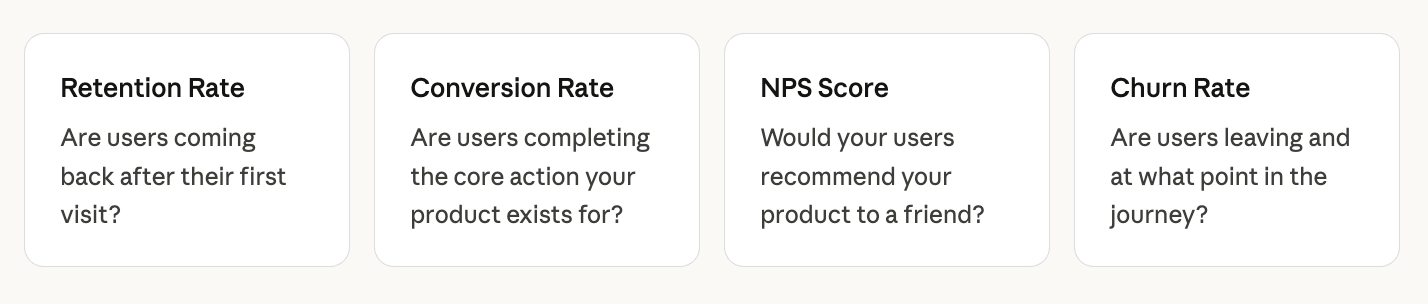
Product thinking also means knowing how to tell if your product is actually working. Features shipped is not a success metric. Real product success metrics track user behavior and business outcomes.
Case Study
Twitter's "Aha Moment" Discovery

Twitter's product team studied user data and found that users who followed at least 30 people in their first few days were far more likely to stick around long-term. That was the "aha moment" when users finally got Twitter's value. So Twitter redesigned its onboarding to push new users toward following 30 accounts as quickly as possible. Retention improved significantly. This is product thinking applied to metrics: find the behavior that predicts success and design the product to drive users toward it.
Five Exercises to Build Your Product Mindset
Product thinking is a habit and habits are built through practice. Here are five exercises you can start today, even as a student.
Do a product teardown
Pick any app you use daily and analyze it through a specific lens: its onboarding, its pricing, or its core user flow. Ask who the user is, what problems it solves well, where it frustrates you, and who its competitors are. Try tearing down PickMe vs Uber in Sri Lanka and you will quickly see how two products with the same core feature (ride booking) make very different product decisions.
Wear a PM's hat
Pick any product and complete this sentence: "Improve [acquisition / engagement / retention / monetization] for [product name]." Then think through how you would actually do it. Add constraints to make it harder: you have only two weeks and one developer. Constraints force creative thinking and that is very close to real product management.
Sketch a UI from memory
Close your laptop and draw Instagram's inbox, or WhatsApp's chat list, completely from memory on paper. This sounds simple but it reveals exactly which design decisions you absorbed instinctively and which you ignored. When you sit down to design your own product later, these patterns will be there waiting for you.
Analyze a product you already work on
If you are building a project in your bootcamp or university, tear it down like a real PM would. Ask: what are three features I would build if I were the PM? Why have they not been built yet? Then go talk to the person who made that decision. The conversation alone will teach you more about product thinking than any lecture.
Start a small side project
Find one real problem in your daily life and try to solve it. Even a simple WhatsApp bot or a Google Form with a spreadsheet counts as an MVP. Go through the full cycle: research the problem, define your user, sketch a solution, build a minimal version, show it to five people, and learn from their reactions. Nothing builds product thinking faster than shipping something real.
The Difference Between a Developer and a Product Thinker
Here is a scenario. A user says: "Can you add an export to CSV button?"
A developer thinks: "How do I implement a CSV export function?"
A product thinker thinks: "Why do they need to export data? What are they doing with it? Is there a better way to give them what they actually need without making them leave the app?"
Sometimes the answer is yes, build the CSV export. But sometimes the answer is a better reporting dashboard inside the app. You cannot know which is right unless you asked the deeper question first.
"Product thinking is not about knowing the right answers. It is about asking the right questions before you pick up a keyboard."
Product thinking is a way of seeing the world. Once you develop it, you will never look at an app the same way. You will notice when a sign-up flow is too long, when a product is solving the wrong problem, and when a company is building features nobody asked for. Start small. Pick one app today and spend 20 minutes tearing it down.
That is your first step toward thinking like a product manager, and it is a skill that makes every other technical skill you have more valuable.
You may also like

What Is TypeSafe AI?
Discover Jev, TypeSafe AI’s System One Model for fast, type-safe, calibrated AI decisions built for software automation.

What Is Paperclip and How Does It Help You Manage AI Agent Teams?
Learn what Paperclip is, how it manages AI agent teams, controls costs, enables human approvals, and coordinates agents across different AI runtimes.

How Do You Actually Teach Engineering Judgment?
Learn how STEMLink teaches engineering judgment through a four-step approach: learn, build, test limitations, and understand why real-world systems need more.