
What are the Entry Requirements for an M.Sc. in IT in Sri Lanka?
Wondering if you qualify for an M.Sc. in IT in Sri Lanka, especially without an IT degree? Explore common entry pathways, what universities really look for, and how to strengthen your profile or gain skills that open more doors.
What are the Entry Requirements for an M.Sc. in IT in Sri Lanka?
Thinking about doing an M.Sc. in IT in Sri Lanka? Whether you are looking to move into the tech field or deepen your skills for career growth, understanding the entry requirements is essential before you apply.

In this guide, we break down the most common entry requirements for IT-related master’s degrees in Sri Lanka, especially for programs like:
M.Sc. in Software Engineering
M.Sc. in Information Technology Specializing in IT
M.Sc. in Information Technology Specializing in Cyber Security
M.Sc. in Data Science
M.Sc. in Computer Science
Other similar IT-related postgraduate degrees
We have also included tips on how to prepare if you do not fully meet the criteria yet.
Common Entry Requirements for M.Sc. in IT Programs
Entry criteria vary slightly from university to university, but across many private and government universities in Sri Lanka, the general requirements are similar.
Here is what most universities look for when admitting students to M.Sc. in IT or related master’s programs.
1. Educational Qualifications
Most universities accept applicants through multiple pathways. Below are the most common options.
Pathway 1: Bachelor’s Degree in IT or a Related Field
This is the most straightforward entry path.
You are generally eligible if you have one of the following:
A bachelor’s degree in IT, Computer Science, Software Engineering or a closely related discipline from a recognized university, or
A bachelor’s degree in Engineering with a significant IT or computing component
Some universities may also specify a minimum GPA or class, such as a second-class lower or higher.
Pathway 2: Bachelor’s Degree in a Non-IT Field with IT Experience
If your first degree is not in IT, you can still qualify for an M.Sc. in IT, depending on your work background.
For example, you may be eligible if you have:
A bachelor’s degree in a non-IT field such as business, science or arts, plus
Professional experience in IT, software development, systems administration, data analysis or related roles
Some universities may ask for a minimum of 1 to 3 years of relevant work experience in the IT industry.
This pathway is especially useful for:
Career switchers who started in another field and later moved into tech
Professionals who work closely with IT systems, software, or digital tools
Pathway 3: Professional Qualifications plus Experience
If you do not have a traditional bachelor’s degree in IT, some universities consider professional qualifications combined with experience.
For example, you may qualify if you have:
Professional or academic qualifications such as those from BCS, ACS, NCC or equivalent recognized bodies
Plus several years of relevant work experience in IT or computing
Each university has its own evaluation process for these cases. Strong professional certifications, hands-on experience and possibly an interview can increase your chances of selection.
Pathway 4: Other Equivalent Qualifications
Some universities mention “equivalent qualifications” approved by the university senate or academic council.
This may include:
Foreign degrees or diplomas in IT or computing
Combined study and work experience evaluated on a case-by-case basis
If you are unsure whether your background qualifies, it is worth contacting the university admissions office directly.
2. Work Experience Requirements

Work experience may not always be compulsory, but for many M.Sc. in IT programs in Sri Lanka, it is a major advantage, especially if your first degree is not in IT.
You may be required to have:
1 to 3 years of full-time experience in IT, software development, networking, systems engineering, data science or similar fields
Documented proof such as service letters, appointment letters, or a CV with references
Even when it is not mandatory, relevant experience:
Makes your application stronger
Helps you better understand advanced concepts taught in the program
Supports your final research or project work
3. English Language Proficiency
Most IT-related master’s programs in Sri Lanka are conducted in English. Because of this, universities may require proof of English language proficiency, especially for students who completed their schooling or undergraduate studies in a language other than English.
You may be asked to provide one of the following:
IELTS or TOEFL scores, especially for foreign students or those who studied in a non-English medium
Proof that your bachelor’s degree was conducted in English
Passing a university-specific English placement test or interview
Even if it is not stated as a formal requirement, good English skills are important for reading research papers, writing assignments, presentations and technical communication.
4. Interviews or Entry Tests
Some universities conduct selection interviews or aptitude tests as part of the admission process.
These may be used to:
Assess your technical background
Check your motivation and readiness for postgraduate study
Evaluate borderline or non-traditional applicants
You might be asked questions related to:
Basic IT concepts such as programming, databases, networking, operating systems
Your past academic or work experience
Your goals and reasons for pursuing an M.Sc. in IT
Some programs may also have an entrance exam that tests logical reasoning, mathematics and basic computing knowledge.
Differences in Entry Requirements by University Type
In Sri Lanka, M.Sc. in IT programs are offered by both government and private universities. While the core requirements are similar, there can be differences in how strict or flexible they are.
Government Universities

Government universities such as the University of Moratuwa, University of Colombo, University of Peradeniya and others often have more structured and competitive entry criteria.
They may require:
A recognized bachelor’s degree in IT or a related field, often with a minimum class or GPA
Relevant work experience for certain programs
Entrance exams and interviews
Seats are usually limited and admission can be highly competitive.
Private Universities and Institutes

Reputed private universities and institutes in Sri Lanka, including those affiliated with foreign universities, may offer more flexible entry pathways.
They might:
Accept applicants with non-IT degrees plus experience
Consider professional qualifications like BCS, ACS, etc.
Provide bridging or foundation modules for students who need to catch up on IT fundamentals
However, the quality and recognition of the program still depend on accreditation, curriculum, industry links and faculty. Always check whether the degree is recognized locally and internationally.
Can You Apply Without a Degree in IT?
Yes, in many cases you can.
If your first degree is not in IT but you are passionate about technology and have gained IT-related experience, you still have options.
You may be eligible if:
You have a bachelor’s degree in another field plus IT work experience
You hold a mix of professional qualifications and hands-on experience
You complete a bridging program, conversion course or diploma that prepares you for postgraduate IT study
This path is ideal for:
Business analysts who want to move into software or data roles
Engineers, science graduates, or finance professionals who work closely with IT systems
Career switchers moving from non-tech careers into IT or software development
If you are not sure whether you qualify, do not hesitate to contact admissions officers. Many universities are open to non-traditional candidates, especially those who can demonstrate strong motivation and relevant skills.
Documents You Typically Need for Application
When applying for an M.Sc. in IT in Sri Lanka, you will usually need to prepare the following documents:
Copies of degree certificates and transcripts
CV or resume that highlights relevant work experience, skills and projects
Proof of English proficiency, if required
Letters of recommendation or referees for academic or professional references
Personal statement or statement of purpose explaining your goals and reasons for applying
Copy of NIC or passport
Some universities may also ask for:
Certified copies of documents
Application fee payment slips
Portfolio or technical project evidence for certain specialized programs
How to Improve Your Chances of Admission
If you are worried that your background might not fully match the entry criteria, here are some ways to strengthen your profile.
1. Gain Practical IT Experience
Hands-on experience can often compensate for a non-IT degree.
You can build experience by:
Working in IT support, software development, QA, networking or data roles
Taking part in internships, freelancing or part-time tech jobs
Building your own projects such as websites, apps or small systems and documenting them in a portfolio
2. Complete Short Courses or Diplomas in IT
Short courses, professional certifications and diplomas can show your commitment and give you a stronger technical foundation.
Look for:
Certificates in programming, databases, cloud, networking or cybersecurity
Diplomas or higher diplomas in IT or computing
Recognized certifications like AWS, Cisco, Microsoft, etc.
3. Prepare Well for Interviews or Entry Tests
If the university conducts an interview or entrance exam, preparation makes a big difference.
Focus on:
Revising core IT fundamentals such as programming logic, databases, operating systems and networking
Being clear about your career goals and how the M.Sc. in IT will help you
Showing that you are ready for the workload and academic rigor of a master’s program
4. Build a Strong Statement of Purpose
Your statement of purpose is your chance to explain:
Why you want to study IT at the master’s level
How your background, even if non-IT, connects to your future goals
What you plan to do after completing the degree
Be honest, specific and focused on your long-term vision.
Is an M.Sc. in IT the Right Choice for You?
An M.Sc. in IT can be a strong choice if you want to:
Move into higher-level technical roles
Switch into the IT industry from another field
Strengthen your profile for roles in software engineering, systems design, data, cyber security or research
However, it is not the only path into tech.
If you are just starting out, or mainly want to become a software developer or full-stack engineer, intensive practical programs or bootcamps focused on coding, projects and real-world skills may be a faster and more affordable route.
Learn Modern IT and AI Skills with STEM Link
Sneak peak into our Bootcamps 👉
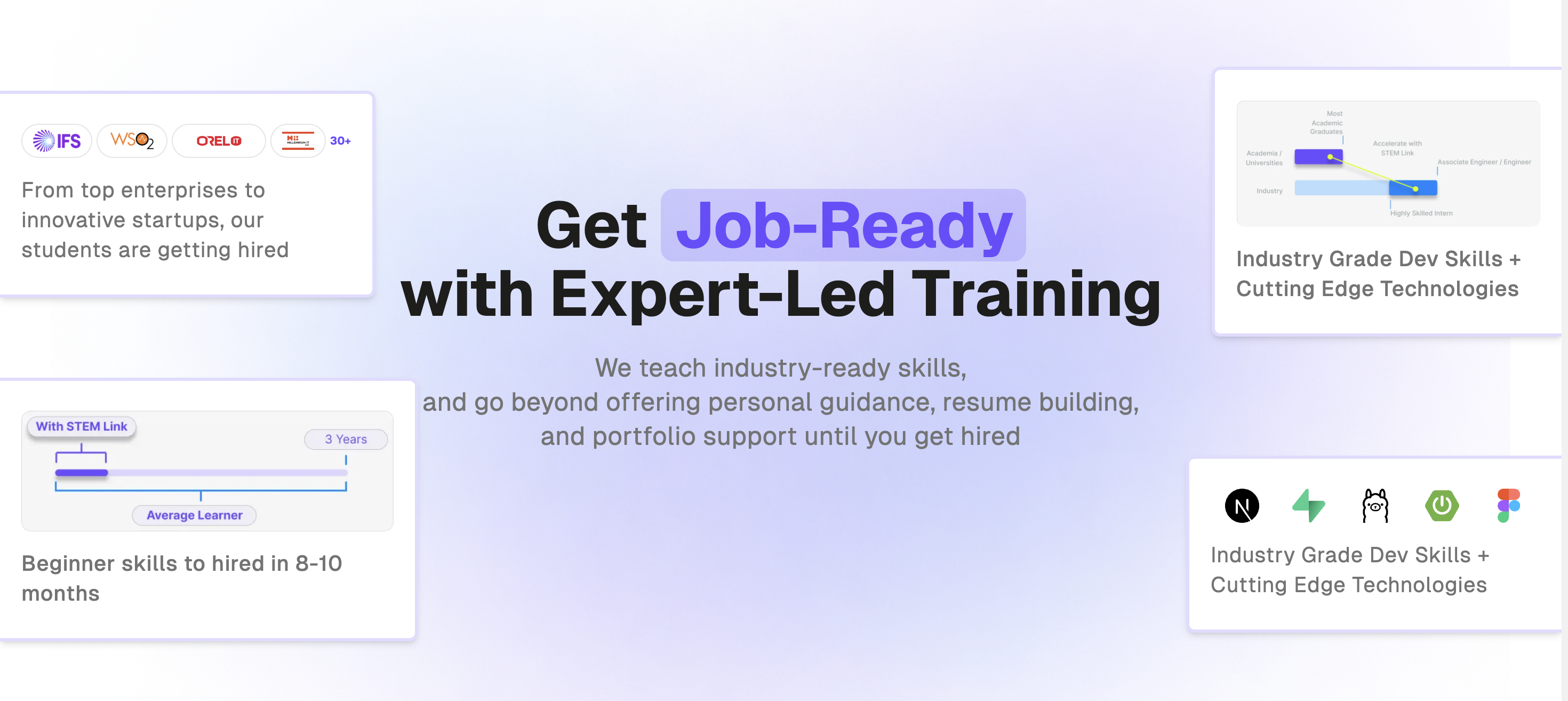
At STEM Link, we help learners from all backgrounds build real, job-ready tech skills through hands-on training in areas such as:
AI-first Full-stack development with MERN, Clerk, Stripe, Vercel, NextJS and more
Spring Boot backend development
UI/UX design for modern web and mobile apps
IT project management for aspiring tech leads and managers
AI Engineering for aspiring Multi agentic System developers and automations specialists.
Our focus is on practical learning, guided mentorship and building portfolio projects that employers value.
If you are planning to apply for an M.Sc. in IT later, our programs can help you:
Strengthen your technical foundation
Gain real-world project experience
Build a portfolio that supports both job applications and postgraduate admissions
Whether you choose a master’s degree, a bootcamp or both, what matters most is building strong, practical skills and a clear career direction.
Here's what you have to know in a nutshell
The entry requirements for an M.Sc. in IT in Sri Lanka usually depend on your academic background, work experience and English proficiency. Even if you do not have a traditional IT degree, there are still pathways available, especially if you have relevant experience or are willing to build your skills through additional training.
Take time to research specific university requirements, prepare your documents and, if needed, start building your technical skills through courses, projects or guided programs.
If you would like guidance on developing your IT and software skills, or want to understand which learning path suits your goals, STEM Link is here to support you.
You may also like

What Is TypeSafe AI?
Discover Jev, TypeSafe AI’s System One Model for fast, type-safe, calibrated AI decisions built for software automation.

What Is Paperclip and How Does It Help You Manage AI Agent Teams?
Learn what Paperclip is, how it manages AI agent teams, controls costs, enables human approvals, and coordinates agents across different AI runtimes.

How Do You Actually Teach Engineering Judgment?
Learn how STEMLink teaches engineering judgment through a four-step approach: learn, build, test limitations, and understand why real-world systems need more.