
What is Kimi K2.6?
Discover Kimi K2.6, Moonshot AI’s groundbreaking open-source multimodal AI model built for autonomous coding, research, and multi-agent workflows. With a 1-trillion-parameter Mixture of Experts architecture, 256K context window, and Agent Swarm technology, Kimi K2.6 delivers frontier-level performance, empowering developers to build faster, smarter, and more cost-effective AI applications.
What is Kimi K2.6?
Moonshot AI just released something significant. Kimi K2.6 landed on April 20, 2026, and it is redefining what open-source agentic models can actually do. This is not incremental improvement. This is architecture-level change.
Let me walk you through what this means for anyone building with AI.
What You Need to Know About Kimi K2.6

Kimi K2.6 is an open-source multimodal agentic model built from the ground up for three things: autonomous long-horizon coding, AI-driven design, and multi-agent orchestration.
The model uses a Mixture of Experts architecture with 1 trillion total parameters. Critically, only 32 billion parameters activate per token. That matters for cost and inference speed. You get the capability of a trillion-parameter model at roughly the inference cost of a 32-billion dense model.
It supports a 256K token context window, native image and video input through a 400M-parameter MoonViT vision encoder, and native INT4 quantization. The weights are open source on HuggingFace under a Modified MIT license. You can run it locally, deploy it on your own hardware, or access it via API through one of nine different providers.
Benchmark Performance: Where Kimi K2.6 Leads
When you look at benchmarks that measure actual engineering work, the numbers matter.
On SWE-Bench Pro, which tests real software engineering tasks, <cite index="14-1">Kimi K2.6 posts 58.6 percent, topping other frontier models</cite>. This is not a lab benchmark. This is about taking actual GitHub issues and solving them with code.
For tool-augmented reasoning work, <cite index="7-1">K2.6 achieves 54.0 on HLE-Full with tools, outperforming GPT-5.4 at 52.1, Claude Opus 4.6 at 53.0, and Gemini 3.1 Pro at 51.4</cite>.
On deep research tasks, the gap widens. <cite index="4-1">K2.6 scores ahead on DeepSearchQA accuracy</cite> with 83.0 percent accuracy where GPT-5.4 achieves 80.6 percent.
<cite index="14-1">Terminal-Bench 2.0 shows K2.6 at 66.7 percent</cite>, and on web research with browsing, <cite index="5-1">K2.6 scores 86.3 percent on BrowseComp Swarm versus GPT-5.4's 78.4 percent</cite>.
The pattern is consistent. When a task involves tools, real code, or actual engineering work, Kimi K2.6 competes at the frontier.
Agent Swarm: The Real Innovation
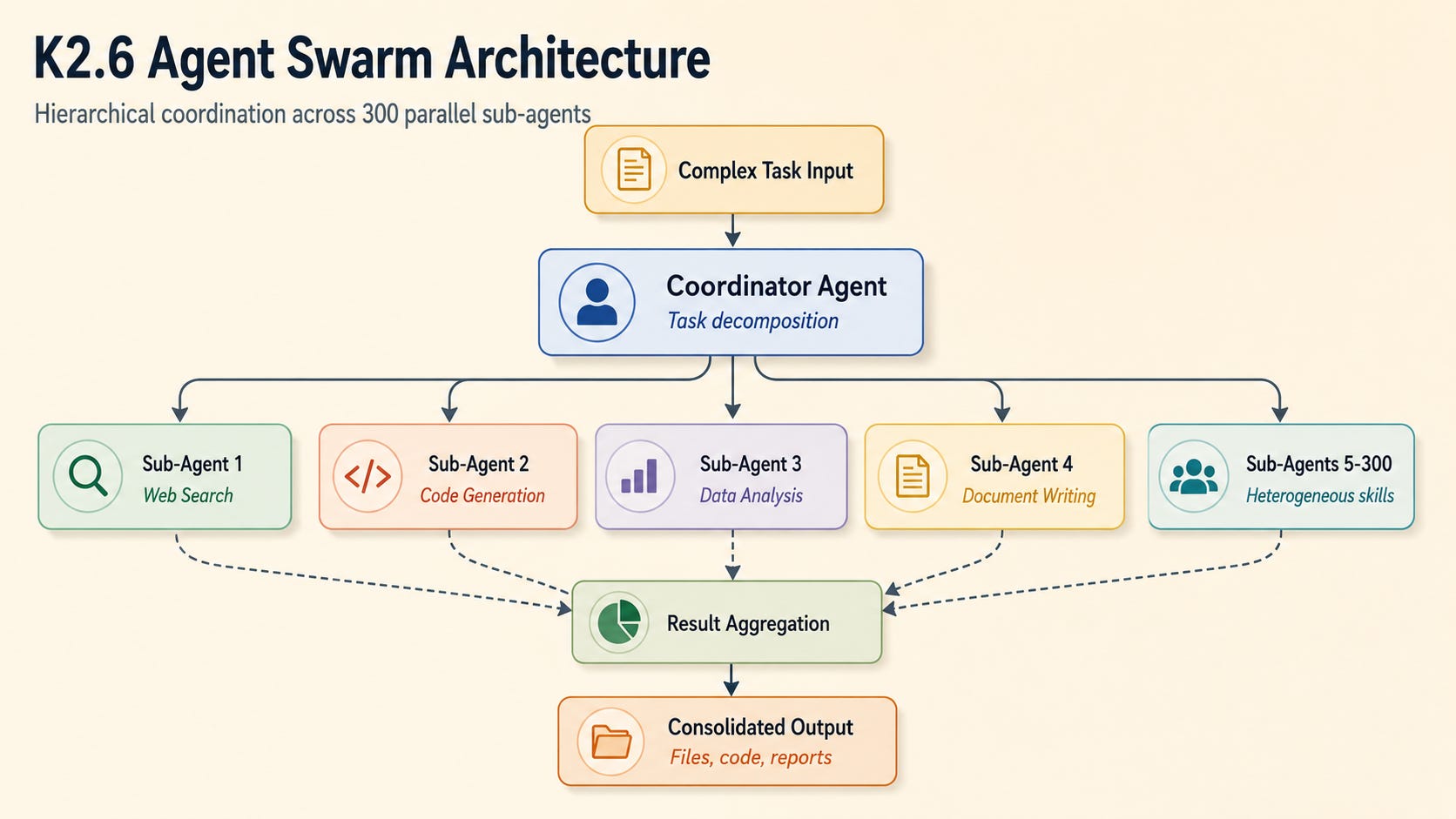
Here is where Kimi K2.6 becomes genuinely different from everything else.Agent Swarm is not a wrapper around a single model. It is baked into the model architecture itself. <cite index="7-1">You can deploy up to 300 parallel sub-agents executing 4,000 coordinated steps from a single prompt</cite>. This is a 3x scaling jump from the previous K2.5 version, which topped out at 100 agents and 1,500 steps.
The way it works: you write one prompt describing what needs to happen. The model reads it, decomposes the work into parallel subtasks, spawns specialized sub-agents, and manages the entire execution autonomously. No manual workflow configuration. No predefined roles. The model figures out the organization it needs and builds it on the fly.
<cite index="2-1">At the mechanical level, Agent Swarm decomposes a complex task into heterogeneous subtasks, spawns specialized sub-agents to execute them in parallel, and synthesizes their outputs through a shared state coordinator</cite>.
The performance gains are measurable. <cite index="10-1">K2.6 Agent Swarm reduces critical steps by 3x to 4.5x in large-scale search scenarios compared to single-agent approaches</cite>.
What does this look like in practice?
Real Examples of What Kimi K2.6 Can Do
One internal test: <cite index="4-1">K2.6 autonomously overhauled an 8-year-old financial engine over 13 hours, delivering a 185 percent throughput improvement through 4,000 plus coordinated steps</cite>. This was not guided execution. This was a single prompt setting up the goal, and the model autonomously refactoring, testing, and optimizing for 13 continuous hours.
Another case: Agent Swarm deployment for parallel coding tasks. A single prompt can refactor 60 Express route handlers from callbacks to async/await, add error boundaries, and update tests across the entire codebase. The orchestrator decomposes this into groups: 30 agents handling route migration, 20 agents adding error boundaries, 10 agents updating tests. All running in parallel.
Literature review synthesis works the same way. Hand it 40 research PDFs and a request for a 100-page academic analysis. Multiple writing-focused sub-agents each handle a section. Output comes back with proper citations, methodology sections, and cross-referenced analysis.
The model can produce 100+ files from a single run. Spreadsheets, websites, design systems, slide decks, code repositories. All in one autonomous execution.
Architecture Details That Matter
<cite index="2-1">K2.6's coordination uses PARL (Parallel-Agent Reinforcement Learning) training</cite>, which means the orchestration logic improves through training rather than being bolted on as infrastructure.
or long-horizon work, the model builds persistent memory across thousands of tool calls. This is not just sequence length. This is a durable state system that lets the model maintain strategy, branch on prior attempts, and pivot when a tactic stops working. <cite index="20-1">The model sustains 12-hour execution traces with memory patterns that include regression testing against known-good states and regime pivots when strategies are exhausted</cite>.
Inference engine support is broad. <cite index="11-1">K2.6 officially supports vLLM, SGLang (v0.5.10+), and KTransformers, all exposing OpenAI-compatible APIs</cite>.
How to Actually Use Kimi K2.6
Three paths exist depending on your preference and workload.
Path one: Use the web interface at kimi.com. Select K2.6, choose your mode (Instant for fast responses, Thinking for deep reasoning), and describe what you need. For complex tasks, enable Agent Swarm mode. The interface shows agent count and progress as the swarm executes.
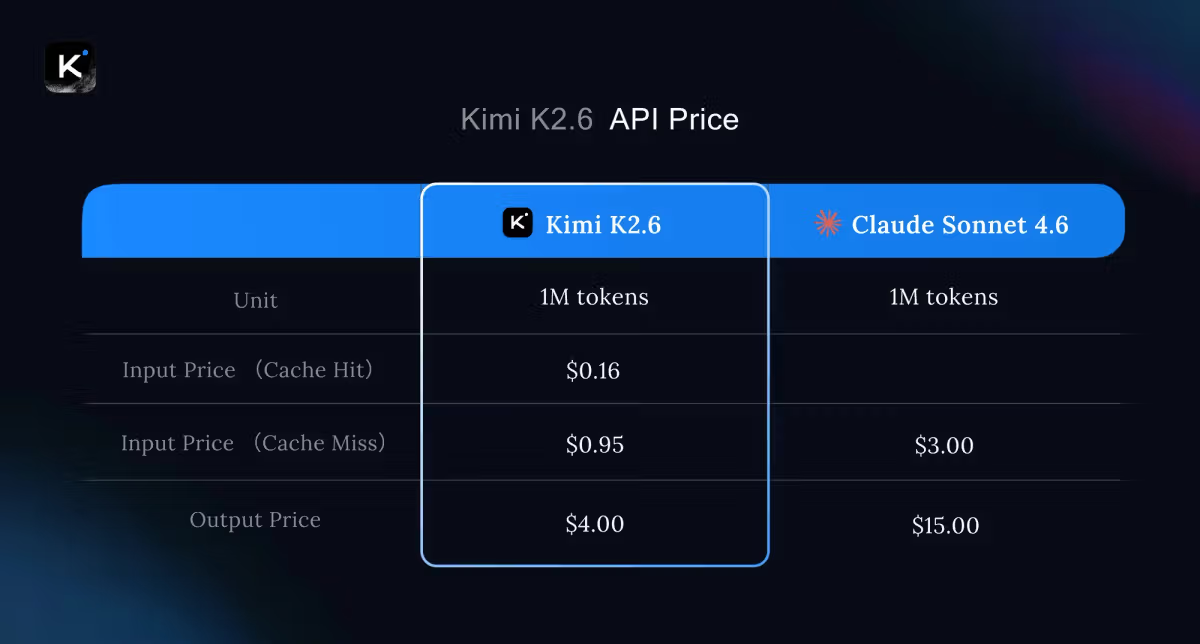
Path two: Call the official Moonshot API. <cite index="4-1">API billing is approximately 0.60 dollars per 1 million input tokens and 2.65 dollars per 1 million output tokens</cite>. This works with the OpenAI-compatible interface using the model identifier "kimi-k2.6".
Path three: Deploy it yourself. <cite index="11-1">K2.6 weights are available on HuggingFace in INT4 quantization at approximately 594 GB</cite>. <cite index="20-1">Running K2.6 locally requires at least 350GB of combined RAM and VRAM for Q2 quantization, with full-quality inference requiring 8 times H100 or H200 GPUs</cite>.
For production workloads, K2.6 is available across nine API providers. Pricing and performance characteristics vary by provider, so routing different workloads to different endpoints makes sense. <cite index="19-1">Parasail offers the lowest blended pricing at 1.15 dollars per 1 million tokens, while Clarifai leads on throughput at 157.2 tokens per second</cite>.
When Kimi K2.6 Wins and When It Does Not
Kimi K2.6 excels at tasks with parallel structure. Large literature reviews. Multi-file code refactoring. Batch data enrichment. Any work that decomposes into independent subtasks benefits from the native swarm architecture.
It is strong on tool use, research synthesis, and long-horizon execution. If your workload involves making API calls, browsing the web, processing documents, and reasoning over those results, the benchmarks show clear wins against competitors.
What it is not optimized for: pure mathematical reasoning or competitive programming. On AIME 2026 and GPQA-Diamond, GPT-5.4 still leads by 2 to 3 points. If your primary concern is contest math, other models are the stronger choice.
Context window caps at 256K tokens. If you need a 1 million token context, DeepSeek V4 is the alternative. The tradeoff: V4 is weaker on tool use and agentic work but supports longer context and costs significantly less on math-heavy workloads.
Why This Matters for Developers
The open-source space just got faster.
Before K2.6, if you wanted production-grade agentic capability, you had two options: proprietary APIs (expensive, locked in, rate-limited) or building your own orchestration layer with CrewAI or LangGraph (complex, requires architecture work, harder to debug).
Kimi K2.6 absorbs the orchestration into the model itself. You define the task once. The model handles decomposition, routing, fault recovery, and synthesis. No infrastructure layer to maintain. No workflow templates to design. The code footprint shrinks.
For teams already comfortable with open weights, this is compelling. For teams running cost-sensitive workloads, the API pricing at 0.60 dollars input and 2.65 dollars output is in line with other frontier open models and significantly cheaper than GPT-4 and Claude Pro.
For anyone working on multi-agent systems, tool use, or autonomous coding, K2.6 just became the default comparison point.
The Technical Take
Kimi K2.6 is the most complete agentic model in the open-source frontier. It builds memory into the model itself rather than bolting it on. It scales Agent Swarm to 300 sub-agents without losing coordination. It benchmarks against closed proprietary systems and wins on the categories that matter for real work: code, tool use, research, and long-horizon execution.
The release is not oversold. The benchmarks are third-party validated. The use cases in their blog posts are credible. The code you can actually run.
If you are evaluating AI models for production work involving coding, research, or agentic workflows, Kimi K2.6 deserves serious attention. Start with the free tier. Build something that benefits from parallel execution. See what happens.
You may also like

What Is TypeSafe AI?
Discover Jev, TypeSafe AI’s System One Model for fast, type-safe, calibrated AI decisions built for software automation.

What Is Paperclip and How Does It Help You Manage AI Agent Teams?
Learn what Paperclip is, how it manages AI agent teams, controls costs, enables human approvals, and coordinates agents across different AI runtimes.

How Do You Actually Teach Engineering Judgment?
Learn how STEMLink teaches engineering judgment through a four-step approach: learn, build, test limitations, and understand why real-world systems need more.