
Cloudflare Meltdown Again: 20% of The Internet Is Down alongside Notion & LinkedIn
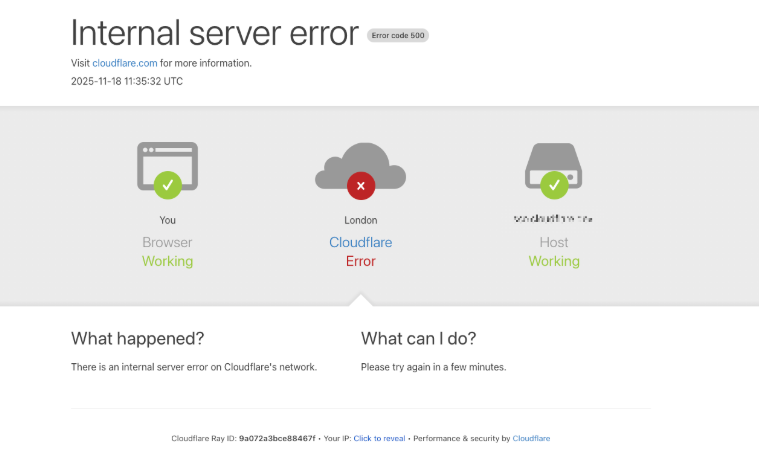
Cloudflare has a global service disruption that took nearly 20 percent of the internet offline. Millions of users were suddenly met with 500 Internal Server Errors, and major platforms stopped responding. Essential services such as npm, LinkedIn, Stack Overflow, Canva, Claude, Perplexity, and Clerk all went down at the same time, creating a chain reaction across the digital world.
Cloudflare Meltdown Again: 20% of The Internet Is Down alongside Notion & LinkedIn
Imagine you finish your lunch break to continue your development work, only to find you cannot install any node modules anymore but instead see a 500 error on your web interface. You check DownDetector to identify the trouble, only to see DownDetector is Down TOO!
More than 2 million Node Packages are Down Too
If this is starting to feel like a trilogy, you are not alone. The first outage disrupted the morning routines of half the planet. This one hit mid-afternoon and took down an entirely different set of digital arteries. Same core problem. Same ripple effect. Different flavor of chaos.
The December 5 failure was shorter but sharper. The indicators were instant. A chunk of high traffic, high dependency platforms simply stopped responding.
Here is the confirmed blast radius during the 9:50 AM to 10:10 AM in Greenwich Mean Time (GMT/UTC) window:
Cloudflare
npmjs (meaning millions of developers globally experienced npm install failures)
LinkedIn
Stack Overflow
Medium
Canva
Crunchyroll
Epic Games services
Clerk authentication
Claude
Perplexity
Notion
The developer ecosystem was hit especially hard. Entire CI pipelines stalled. Yarn and pnpm users fared no better. If your workflow depended on pulling packages from npm, you were effectively offline.
This was not silence in the background. This was the engine room of the internet coughing blood for twenty minutes.
Why This Keeps Happening
The uncomfortable truth from November still stands. Cloudflare’s infrastructure is so deeply embedded in the routing, caching, security, and DNS flow of the internet that even short-lived issues manifest like global weather events.
A few minutes of Cloudflare instability translates into:
Requests timing out
Authentication loops breaking
APIs failing across services
Entire frontends refusing to load
Build systems freezing
Payment gateways stuck in limbo
Apps throwing generic 500s at users who have no idea what Cloudflare even is
When the underlying pipes constrict, everything downstream suffocates.
The npm Factor
The npm outage deserves special attention. npm is not just a registry. It is one of the core dependency graphs of the modern web. Three million packages hosted. Hundreds of billions of downloads per month. Every startup, enterprise, and indie dev depends on it.
During this outage:
npm install threw 500 errors
Private registry proxies broke
Vite, Next, Nuxt, Electron, React Native, Node servers all stalled
Docker builds that pulled from npm failed
Automated deployments froze mid-build
Package managers kept retrying endlessly with no fallback
It was a reminder that even with distributed caching, CDNs, and mirrors, the lookup layer that Cloudflare accelerates remains a single point of failure for the entire JavaScript ecosystem.
A Pattern Is Emerging
Two outages in less than a month is not a coincidence. It is a signal. A warning about the saturation of complexity in global infrastructure.
Large scale network systems rarely fail because of one thing. They fail because:
A small subsystem becomes overloaded
An automated job misbehaves
A configuration change exposes a dormant bug
A routine update interacts with an unexpected traffic pattern
A dependency somewhere deep in the stack collapses under load
Cloudflare has thousands of interlocking systems. The boundary between “normal operation” and “cascading failure” gets thinner each year.
The Digital World We Live In
This outage is another demonstration that the internet is held up by a small group of companies whose systems are so massive and so complex that even minor disruptions ripple outward into every industry.
Today’s collapse hit professional networks, developer platforms, media platforms, AI tools, content hosts, gaming services, and creative tools. Not niche categories. Fundamental pillars of modern digital life.
Twenty percent of the entire internet relying on one network layer is convenient on good days and catastrophic on bad ones.
What This Means Going Forward
We are at a point where resilience cannot be optional. If your business touches the internet, you are dependent on infrastructure you do not control. Redundancy is no longer a luxury. Multi vendor CDNs, multi region DNS, fallback routing, mirror registries, sanity checks, and graceful degradation patterns are not theoretical best practices. They are survival strategies. Every outage like this forces the same uncomfortable question:
What breaks if your single primary provider goes dark?
Most Companies still do not have an answer
The Takeaway
The December 5 outage was short but significant. It proved that the November incident was not a one-off. It reinforced the reality that global scale infrastructure, no matter how advanced, can be pushed into failure by the smallest misalignment in traffic, configuration, or timing.
Cloudflare will fix the issue. They always do. But the underlying dependency problem will remain until the industry takes decentralization and redundancy seriously.
Because if twenty percent of the internet can go dark for twenty minutes, it can also go dark for two hours. Or two days. And as history keeps proving, it does not take much for the entire web to wobble.
You may also like

What Is TypeSafe AI?
Discover Jev, TypeSafe AI’s System One Model for fast, type-safe, calibrated AI decisions built for software automation.

What Is Paperclip and How Does It Help You Manage AI Agent Teams?
Learn what Paperclip is, how it manages AI agent teams, controls costs, enables human approvals, and coordinates agents across different AI runtimes.

How Do You Actually Teach Engineering Judgment?
Learn how STEMLink teaches engineering judgment through a four-step approach: learn, build, test limitations, and understand why real-world systems need more.