
Why Companies Are Hiring Again?
Discover why companies are hiring again despite rapid advances in AI. Learn how artificial intelligence is boosting productivity instead of replacing workers, why human skills remain indispensable, and what the future of work means for professionals who can effectively collaborate with AI.
Why Companies Are Hiring Again?
For the past few years, artificial intelligence has dominated conversations about the future of work. Predictions ranged from massive productivity gains to the complete replacement of millions of white-collar jobs. Software developers, designers, analysts, customer support agents, and countless other professionals were told that their roles would soon become obsolete.
Yet, the reality unfolding today looks very different.
Across industries, many organizations are beginning to increase hiring after a period of caution. Rather than replacing employees, businesses are discovering that AI works best as a tool that enhances human productivity instead of eliminating the need for people altogether.
The Gap Between Expectations and Reality
When generative AI became widely accessible, expectations skyrocketed. Many believed that companies would dramatically reduce headcount as AI systems took over routine work. Some even predicted that entire professions would disappear within a few years.
Instead, businesses have encountered the limitations of today’s AI systems. While AI excels at drafting content, generating code, summarizing information, and automating repetitive tasks, it still struggles with complex reasoning, nuanced decision-making, collaboration, and accountability. Human judgment remains essential in most professional environments.
As organizations experimented with AI, many discovered that the technology is most effective when paired with skilled employees rather than used as a complete replacement.
AI Is Increasing Productivity, Not Eliminating Jobs
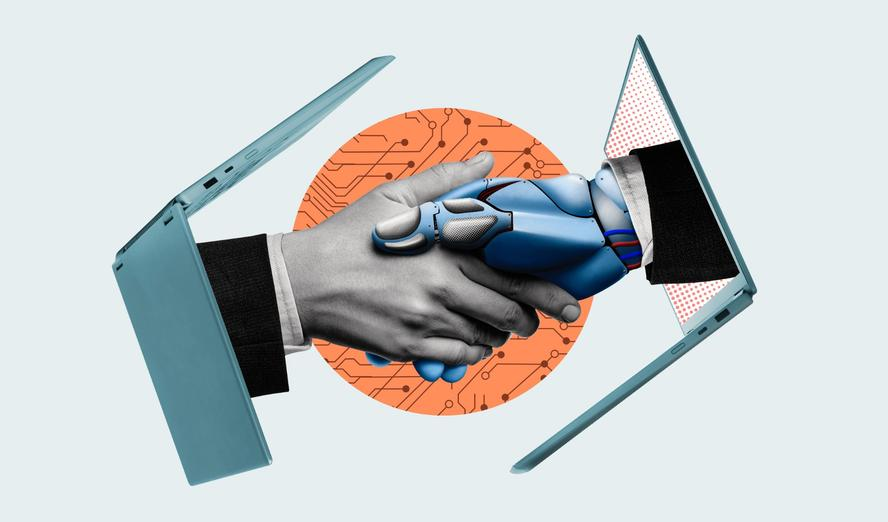
A growing number of business leaders now describe AI as a productivity multiplier rather than a workforce replacement.
Instead of removing employees from the equation, AI allows professionals to spend less time on repetitive tasks and more time solving higher-value problems. Developers can generate boilerplate code more quickly, marketers can draft campaigns faster, and analysts can process information more efficiently. However, the responsibility for reviewing, refining, and making final decisions still rests with people.
History has shown that productivity improvements do not always reduce employment. In many cases, increased efficiency lowers costs, expands demand, and ultimately creates more work rather than less.
Lessons from Previous Technological Revolutions
This pattern is not unique to AI.
Throughout history, transformative technologies have often sparked fears of widespread unemployment. The Industrial Revolution, personal computers, and the internet were all expected to eliminate large numbers of jobs. While many occupations evolved, entirely new industries and career opportunities emerged alongside them.
Economists have long observed that when a technology makes work more efficient, demand often increases rather than decreases. As services become faster, cheaper, and more accessible, more people begin using them, creating additional opportunities for businesses and workers alike.
AI appears to be following a similar trajectory.
Why Hiring Is Returning
The slowdown in hiring over the past few years cannot be attributed to AI alone.
Many organizations adopted a cautious approach after the rapid hiring that followed the pandemic. Economic uncertainty, rising costs, and changing market conditions encouraged companies to pause recruitment while evaluating how AI would impact their operations.
As businesses gained practical experience, many realized that AI was not yet capable of independently performing entire jobs. Instead, they needed employees who understood both their domain expertise and how to effectively leverage AI tools.
Rather than replacing workers, organizations increasingly seek professionals who can collaborate with AI to achieve better outcomes.
The Human Skills That Matter More Than Ever
Ironically, the rise of AI has increased the importance of uniquely human skills.
Critical thinking, creativity, communication, problem-solving, and sound judgment remain difficult to automate. While AI can generate suggestions in seconds, it cannot fully understand business context, organizational goals, ethical considerations, or customer relationships in the same way people can.
For software engineers, simply generating code is no longer enough. Understanding system design, debugging complex issues, making architectural decisions, and collaborating with teams continue to be highly valuable skills.
These capabilities cannot be outsourced entirely to an AI assistant.
Avoiding Skill Degradation
Although AI offers tremendous convenience, there is growing concern that excessive reliance on it may weaken fundamental skills.
When professionals use AI to solve every problem without understanding the underlying concepts, they risk losing the ability to think independently. This is particularly important for students and early-career professionals who are still building foundational knowledge.
AI should accelerate learning not replace it.
Those who combine strong fundamentals with AI tools are likely to outperform those who depend solely on automation.
Looking Ahead
The next several years will likely bring continued advances in AI, but the future is unlikely to resemble the most extreme predictions made during the height of the AI boom.
Businesses are gradually shifting from asking, “Can AI replace this employee?” to asking, “How can AI help this employee become more productive?”
That distinction changes everything.
Rather than eliminating human talent, AI is reshaping the way work is performed. Organizations continue to invest in people because technology alone cannot replace experience, judgment, creativity, and collaboration.
The future of work will not belong to AI alone it will belong to people who know how to work effectively with it.
You may also like

What Is TypeSafe AI?
Discover Jev, TypeSafe AI’s System One Model for fast, type-safe, calibrated AI decisions built for software automation.

What Is Paperclip and How Does It Help You Manage AI Agent Teams?
Learn what Paperclip is, how it manages AI agent teams, controls costs, enables human approvals, and coordinates agents across different AI runtimes.

How Do You Actually Teach Engineering Judgment?
Learn how STEMLink teaches engineering judgment through a four-step approach: learn, build, test limitations, and understand why real-world systems need more.